


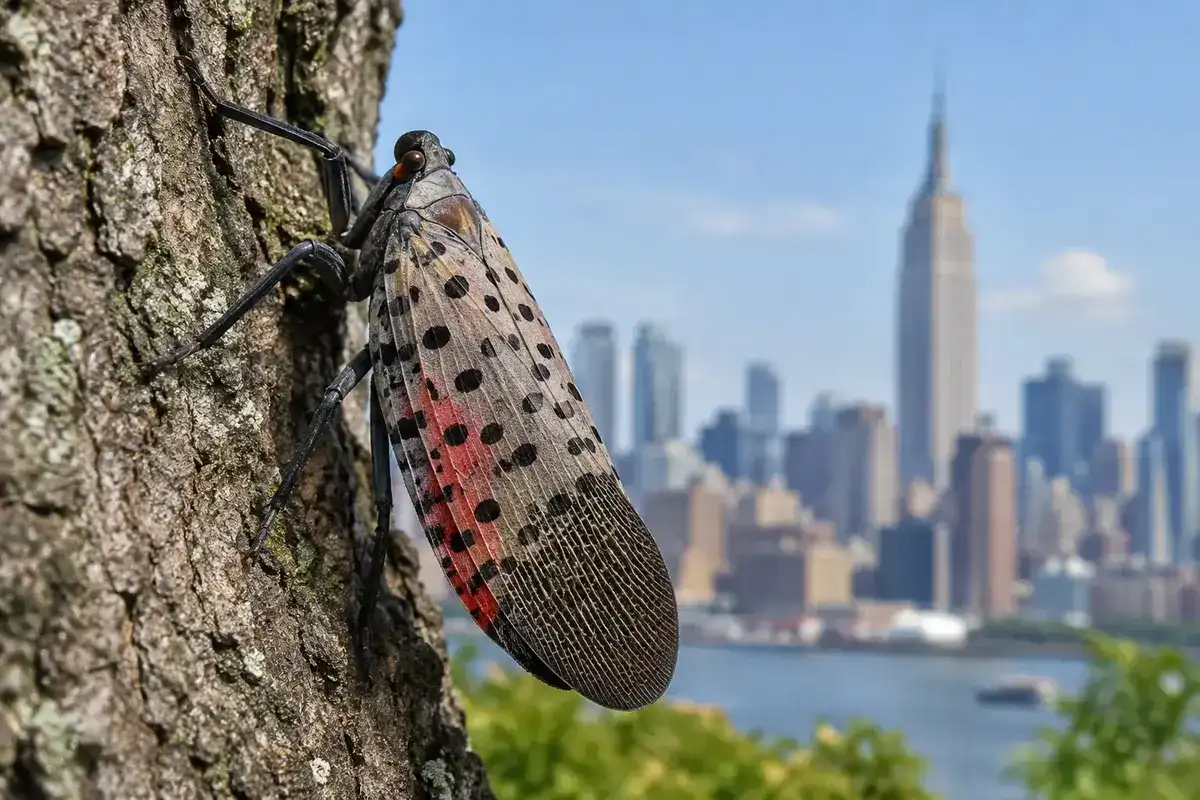
If you’re in Westchester, Long Island, or anywhere in New York City, the answer is simple: kill it immediately by stepping on it or crushing it. According to the New York State Department of Agriculture and Markets, Westchester, Nassau, Suffolk, and all five NYC counties are areas where the spotted lanternfly is already established, so reporting a sighting or collecting a sample isn’t required there. You just squash it on sight. Residents outside those counties are asked to report the sighting right away and keep a sample in the freezer or in rubbing alcohol before killing any additional ones they see.
How to Identify a Spotted Lanternfly
Spotted lanternflies look different at every life stage, which is part of why they’re easy to mistake for a different, harmless insect until you know what to look for.
- Egg masses are about an inch long and hold 30 to 50 eggs. Fresh ones have a light gray, mud-like covering. As they age, that covering turns light tan and starts to look like cracked mud, and once the eggs hatch, the covering flakes off to expose individual eggs that resemble seeds.
- Young nymphs (the first three stages) are black with white spots and have no wings yet, growing from just a few millimeters up to about a quarter inch.
- Older nymphs (the final stage before adulthood) turn bright red, about half an inch long, with black stripes and white spots.
- Adults have gray forewings with black spots, and wingtips outlined in gray. The hind wings show contrasting patches of red and black with a white band. The head and legs are black, and the abdomen is yellow with black bands.
When Spotted Lanternflies Are Active in New York
Based on life cycle patterns observed in the Northeast, adults typically start laying egg masses in September, and egg laying can continue into late November or early December, which puts most of the region’s lanternfly activity squarely in the fall. Those eggs overwinter on trees, fences, and outdoor surfaces and can be found anywhere from October through May. They hatch into nymphs in spring, work through four growth stages over the summer, and reach adulthood by midsummer, when the cycle starts again. In practice, this means if you’re seeing adult spotted lanternflies right now, you’re also likely to find fresh egg masses on the same property within the next few weeks.
Why Spotted Lanternflies Are a Problem
Spotted lanternflies feed on sap from stems, leaves, and tree trunks, and UMass Extension notes they can leave trees weeping from the wounds their feeding causes. They also excrete a sugary residue as they feed that coats the plant and anything sitting beneath it, which can lead to sooty mold. They favor the Tree of Heaven but feed on more than 70 plant species, including grapevines, so a property with ornamental trees, a vegetable garden, or a backyard vine is exactly the kind of place they settle into.
What to Do If You See One in New York
- In Westchester, Long Island, or NYC: Don’t wait and don’t report it. Step on it or crush it right away. No photo or sample is required.
- Outside the established counties: Take a photo first, then collect a sample and keep it in the freezer or in a jar with rubbing alcohol or hand sanitizer. Report it through the state’s SLF reporting option before killing any others you find.
- Egg masses: Scrape them off trees, fences, or outdoor furniture into a bag or container with alcohol or hand sanitizer. A single egg mass can hold up to 50 insects for next season, and egg masses on items like lawn furniture, fencing, play structures, and gazebos are exactly how the insect spreads from one property to another, so it’s worth a quick check before moving any of those outdoors.
Protecting Your Property: When to Call a Professional
Squashing the ones you see helps, but it doesn’t address egg masses hidden high in trees or tucked into bark, and a property with an established host tree can see the same problem return year after year. Optimum Pest Control starts with a free inspection to find lanternfly hotspots on a property (trees, shrubs, gutters, eaves, and the surrounding landscape) and treats at every life stage, including egg masses, nymphs, and adults, using tree-safe, low-impact products. The approach goes beyond a single spray: treatment is done in phases to address the root cause, and follow-up visits are built in for egg masses or new nymphs that show up weeks later. Same-day service is available if you call before noon, and every visit starts with a free inspection and a transparent quote. Because recurrence is possible even after treatment, especially on properties with an established host tree nearby, Optimum also offers annual management for homeowners who want ongoing coverage rather than a one-time visit.
A family-run business with 20+ years serving Westchester, Long Island, and the NYC area, Optimum Pest Control holds a 4.9-star rating from 400+ Google reviews. If spotted lanternflies keep coming back to the same trees or outdoor space, see Optimum’s lanternfly control service or call 516-509-8362.

