


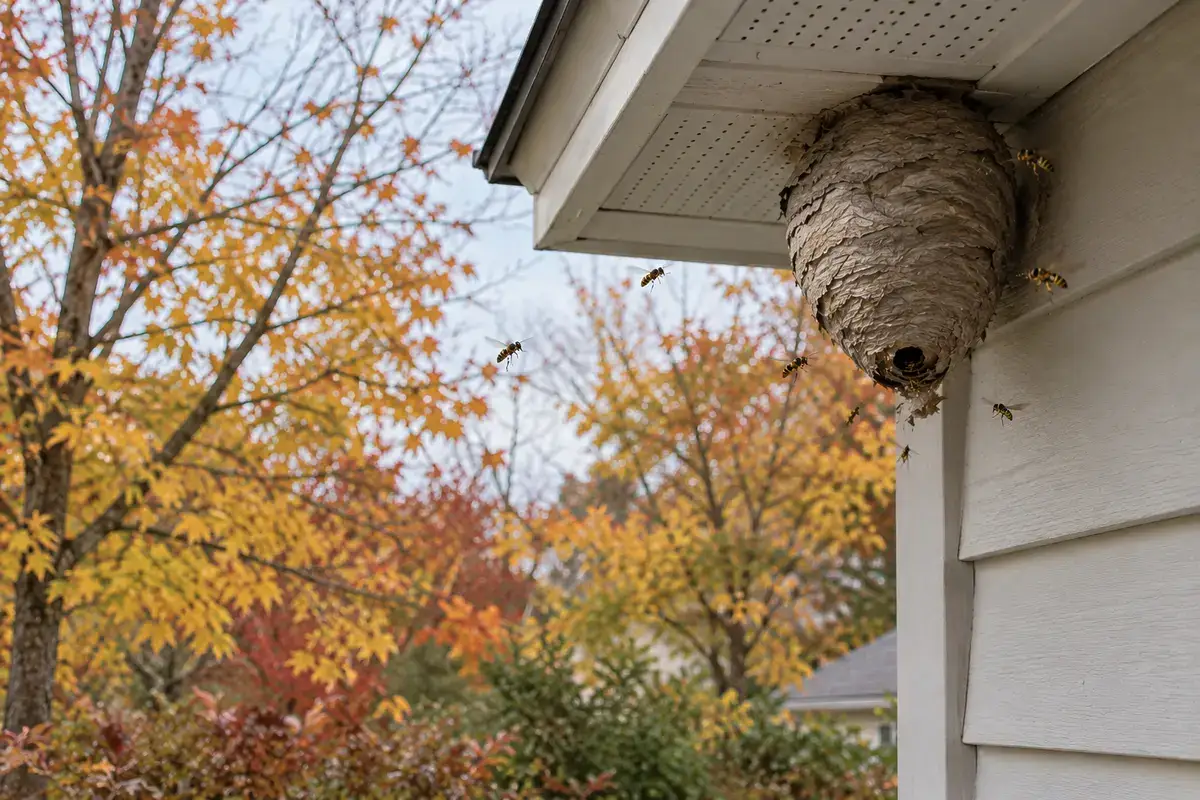
Wasp nest removal gets harder, not easier, once fall arrives, because wasp and yellow jacket colonies reach their largest size and most aggressive behavior in late summer and fall, not in spring or early summer. University of Minnesota Extension reports that yellowjacket populations peak in late summer and fall, with nests holding up to about 5,000 wasps at that point. Each colony starts from a single queen that survived the winter alone and builds an entirely new nest from scratch every spring, which is why a nest barely noticeable in July can hold thousands of workers by October. As natural food sources like flowers and insects become scarce, yellowjackets scavenge aggressively around outdoor food, drinks, and trash, which is why late-season picnics, barbecues, and open garbage cans draw more stings than a backyard did in June. The colony stays active and defensive until a hard freeze, usually in the mid-to-upper 20s degrees Fahrenheit, kills the queen and the remaining workers.
Bee, Wasp, Hornet, or Yellow Jacket: How to Tell Them Apart
Identifying the insect first determines the safest next step, since the removal method differs by species.
- Honey bees are golden brown with thin black stripes and a fuzzy thorax. They build wax honeycomb, usually in a managed hive, and occasionally in a wall void or tree cavity. A honey bee stings once and dies afterward. Honey bees are important pollinators, so relocation is the preferred approach over extermination.
- Paper wasps are slender, with long legs that hang below the body in flight. They build a single exposed comb, with no outer covering, under horizontal surfaces like eaves, beams, and garage ceilings. Paper wasps defend their nest aggressively and can sting multiple times.
- Hornets (including the baldfaced hornet common in the Northeast) are large black insects with white or pale markings. They build enclosed, papery aerial nests in trees or under eaves, and hornet nest removal typically calls for more caution than a wasp nest, since hornets are more aggressive and deliver a more painful sting.
- Yellow jackets are bright yellow with black markings and a hard, shiny body. They build enclosed papery nests, most often underground in old rodent burrows, though some nest in wall voids or attics. Yellow jackets are the most likely of the four to scavenge around people and food in the fall.
Why a Nest Seems to Appear Out of Nowhere in October
A colony that was quietly building all summer becomes obvious in fall for two reasons: its population has grown to its yearly maximum, and its workers start ranging further from the nest in search of food as natural sources dry up. An underground yellow jacket nest near a patio or a baldfaced hornet nest high in a tree can go unnoticed for months and then suddenly produce dozens of stinging encounters once the colony peaks and food becomes scarce nearby. Routine fall yard work, mowing over a hidden ground nest, raking leaves near a foundation, or moving a grill stored against the house, is a common way an undisturbed nest gets triggered without warning. This same late-season shift shows up across other pests too, not just stinging insects. Optimum’s seasonal pest checklist covers what else tends to turn up around a Westchester, Long Island, or NYC property as the weather cools.
When to Remove a Wasp Nest, and What to Do Right Now
Cornell Cooperative Extension of Nassau County advises waiting for frost before removing a wasp, hornet, or yellow jacket nest when possible, since the colony dies off on its own at that point and yellow jacket nest removal is far safer once the colony is inactive. Removing an active nest before frost means dealing with the full, defensive colony rather than an empty one.
If a nest has to come down sooner because of its location (a doorway, a patio, a high-traffic area), Cornell Cooperative Extension recommends treating it after dark, when the insects are least active, checking for remaining activity the next day, and repeating the treatment if needed. Cornell Cooperative Extension also advises reading the product label in full and wearing whatever protective clothing it specifies before attempting treatment. Once activity stops, the nest can be removed the following evening and buried at least 12 inches deep or sealed in a plastic bag.
Even after a nest goes quiet, the season ahead creates a separate concern: the mated queen leaves in fall to overwinter, often in the ground, loose bark, or an unused structure. A home with gaps around siding, soffits, or foundation vents gives a queen an easy place to spend the winter and start a new colony close to the house next spring.
When to Call a Yellow Jacket Exterminator
Honey bee hives should never be treated with pesticide or destroyed. Cornell Cooperative Extension’s guidance is clear that honey bees are too valuable as pollinators to exterminate, and a honeycomb left in a wall void after the bees are killed can leak rancid honey that stains walls and draws other pests. A hive inside a structure needs a beekeeper or pest control professional who can remove and relocate it.
A nest inside a wall void, an attic, or underground near a foundation carries its own risk: a DIY spray treats what’s visible, but a hidden entry point can go unnoticed until someone is stung repeatedly trying to find it. Whether the job is bee relocation or yellow jacket exterminator work, Optimum Pest Control starts every stinging insect call with a free inspection to identify the species and locate the nest. Honey bees are relocated through local beekeepers rather than exterminated. Wasps, hornets, and yellow jackets are removed using professional-grade equipment, with a custom treatment plan and recommendations to reduce the chances of a nest returning to the same spot next season. Anyone with a known allergy to stinging insects is safer leaving removal to a trained technician.
Frequently Asked Questions
Is it safe to remove a wasp nest in winter?
Yes, once the colony has died off at the first hard freeze (mid to upper 20s degrees Fahrenheit), an inactive nest is far safer to remove than an active one in fall, per Cornell Cooperative Extension of Nassau County. Workers can no longer sting once the colony is inactive.
When is the best time to spray or remove a wasp nest?
After dark, when the colony is least active, is the safest timing if a nest can’t wait for frost. Check for activity the next day and repeat if needed. Wearing the protective clothing the product label specifies lowers the chance of getting stung.
When do wasps go away for the winter?
Workers and the old queen die at the first hard freeze. Only newly mated queens survive, overwintering in the ground, loose bark, or an unused structure. Each surviving queen starts an entirely new colony from scratch the following spring.
What is the difference between a wasp and a hornet?
Hornets, including the baldfaced hornet common in the Northeast, are larger, build enclosed aerial nests, and sting more painfully than paper wasps, which build a single exposed comb under eaves. Both can sting multiple times, unlike a honey bee, which stings only once.
Do wasps or hornets build nests in the ground?
Yellow jackets commonly nest underground in old rodent burrows. Paper wasps and baldfaced hornets build their nests above ground, under eaves or in trees. A ground nest is often the hardest type to notice before it gets accidentally disturbed.
Every call starts with a free inspection from a licensed technician, with same-day service available for calls placed before noon. A family-run business with 20+ years serving Westchester, Long Island, and the NYC area, Optimum Pest Control holds a 4.9-star rating from 400+ Google reviews. If a wasp, hornet, or yellow jacket nest is active on your property before winter, see Optimum’s bee, wasp, and hornet removal service or call 516-509-8362.

